
Buying an EV charger should not feel like an electrical engineering project. Start with three questions: How fast do you need to charge? Where will you park? Can your home safely handle the added demand?
Level 1 or Level 2
Level 1 uses a suitable standard 120-volt outlet and typically adds about 2–5 miles of range per hour. It can work for short commutes or some plug-in hybrids, but catching up after a lot of driving can take a while. SCE charging guide
Level 2 uses 240 volts at home. Common 32–48 amp setups can add roughly 20–40 miles per hour, depending on the vehicle. That makes overnight charging more practical for many drivers. Your car’s charging limit still matters; buying a higher-output charger does not make every car charge faster. Manufacturer charging examples
Plug-in or hardwired
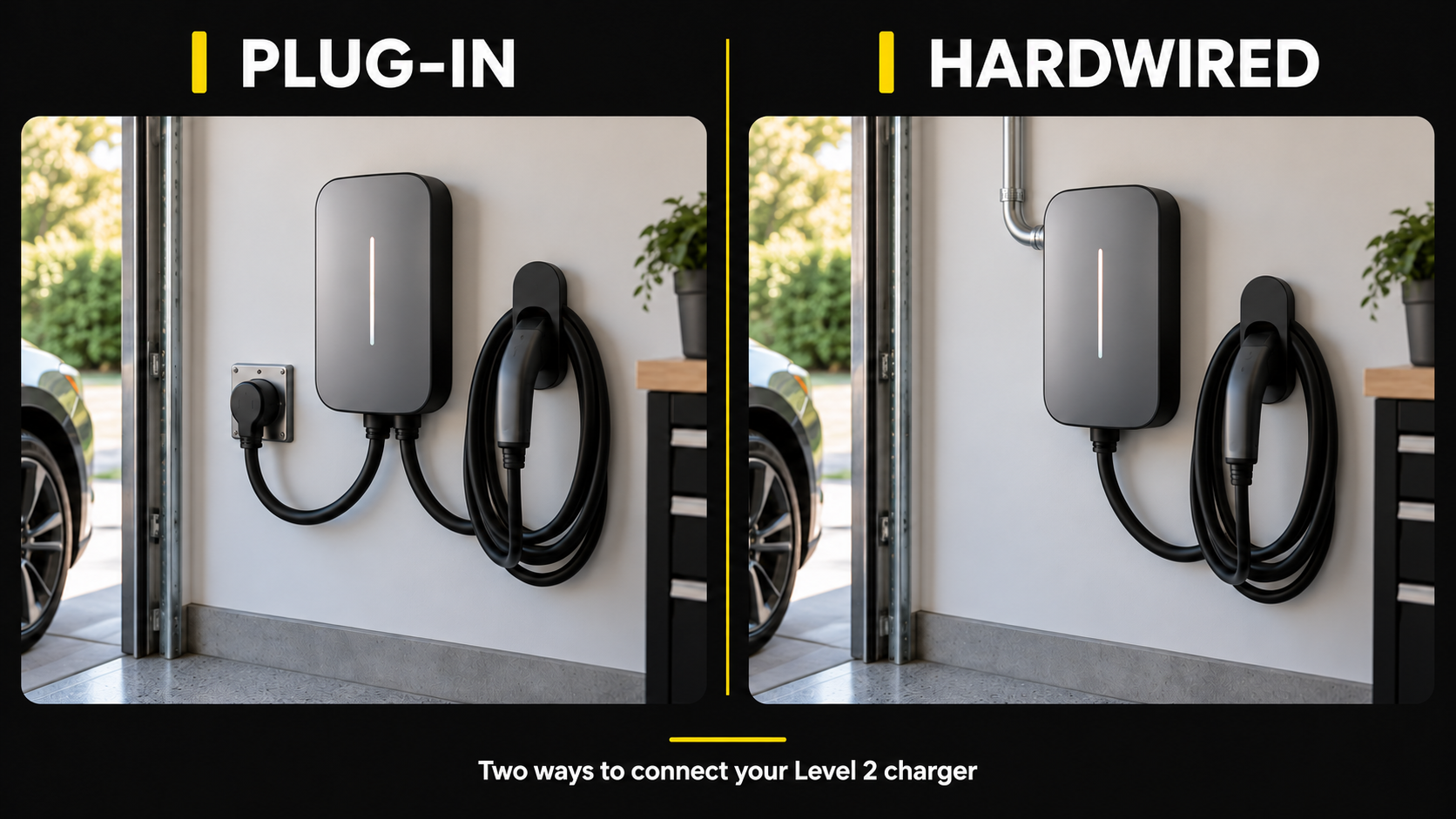
Plug-in: Connects to a compatible outlet, commonly a NEMA 14-50. It can be convenient if you plan to move the charger later, but an existing outlet and its circuit need to be checked.
Hardwired: Connects directly to the circuit wiring for a permanent installation. It removes the plug-and-outlet connection and supports higher charging rates when the equipment and circuit allow.
Both can provide Level 2 charging. For ChargePoint Home Flex, 48-amp charging requires hardwiring; its compatible plug-in versions support up to 40 amps. Installation requirements
Four brands to consider
- Tesla: App controls and scheduling. Universal Wall Connector adds an integrated J1772 adapter for compatible vehicles.
- ChargePoint: Home Flex offers plug-in and hardwired options, with home and public charging information in one app.
- Wallbox: Compact Pulsar Plus equipment with scheduling and optional energy-management features.
- Emporia: Charging and home-energy tools; Pro includes the monitor and load-management system that adjusts charging around household demand.
Choose the correct connector for your vehicle and compare the features you will actually use.
The installation matters as much as the charger
EV charging runs for hours. Loose connections, unsuitable outlets, and undersized wiring can overheat. A plug fitting the outlet does not prove the circuit is ready.
For a plug-in installation, we recommend a listed, heavy-duty receptacle suited to EV charging. Wire size must match the charging load, installation method, and distance. Required GFCI protection must remain in place. EV outlet design · Installation guidance
Specialized Electrical Solutions is a Tesla Certified Installer and holds ChargePoint certification. That knowledge supports proper setup and troubleshooting. Installation records can also help support a warranty claim, although coverage depends on the manufacturer’s terms. Our credentials · Tesla warranty terms
Why installation prices vary
A charger beside your panel is a different project from one across the house or in a detached garage. Longer wiring routes, difficult access, trenching, and panel work can increase the cost. That is why photos and placement details help us prepare an accurate estimate. Installation cost factors
Can your panel handle it
An open breaker space does not automatically mean available electrical capacity. We assess your panel, existing loads, and charging needs before recommending a setup.
You may be able to use a lower charging rate or compatible load management. Other homes need a panel or service upgrade. The goal is reliable charging that fits your home. Power-management options
Ready to charge at home? Fill out our job request form and submit photos of your panel and preferred charger location, or call (714) 926-7942. We serve homeowners throughout Los Angeles, Orange, and Riverside counties.